
Checking Criminal History in Rock Island County
No single database provides a complete Rock Island County criminal record. The free Judici index is the practical first stop for filed local cases. Search by name or case number, and check the daily docket only when the question is whether a matter is set for court that day. A docket date is not an outcome. For records that are not exposed online, the Circuit Clerk offers free viewing at its public terminal and accepts email requests for standard or certified copies.
Start with a full name and spelling variants. A date of birth can help separate people in agency records, though Judici's basic form centers on a name or case number. Keep any booking number, incident number, arrest date, or court number found along the way. These identifiers are more reliable than a name alone when moving between the sheriff, clerk, and Illinois State Police.
- Search Judici for Rock Island County filed cases, using last name, a space, then first name.
- Open the case number and select History to review events, charges, dates, and the current status.
- Check the county jail roster for recent booking or present custody, then call the jail if the listing has changed.
- Request the source incident or arrest report from the agency that made the arrest, not simply from the booking facility.
- Order the needed clerk copy or use ISP Access and Review when an official self-review must reconcile statewide entries.
Note: A search with no result is not proof that no record exists; spelling, timing, venue, and access restrictions can all matter.
Rock Island County Criminal Case Search
Rock Island County's Criminal Division gives one vital formatting rule. A felony number written with a two-digit year must be changed to a four-digit year. Thus, 04CF1234 becomes 2004CF1234. After opening the result, the History link can reveal new hearing dates and later court events. The county's Circuit Clerk page shows its office and online-service routes.
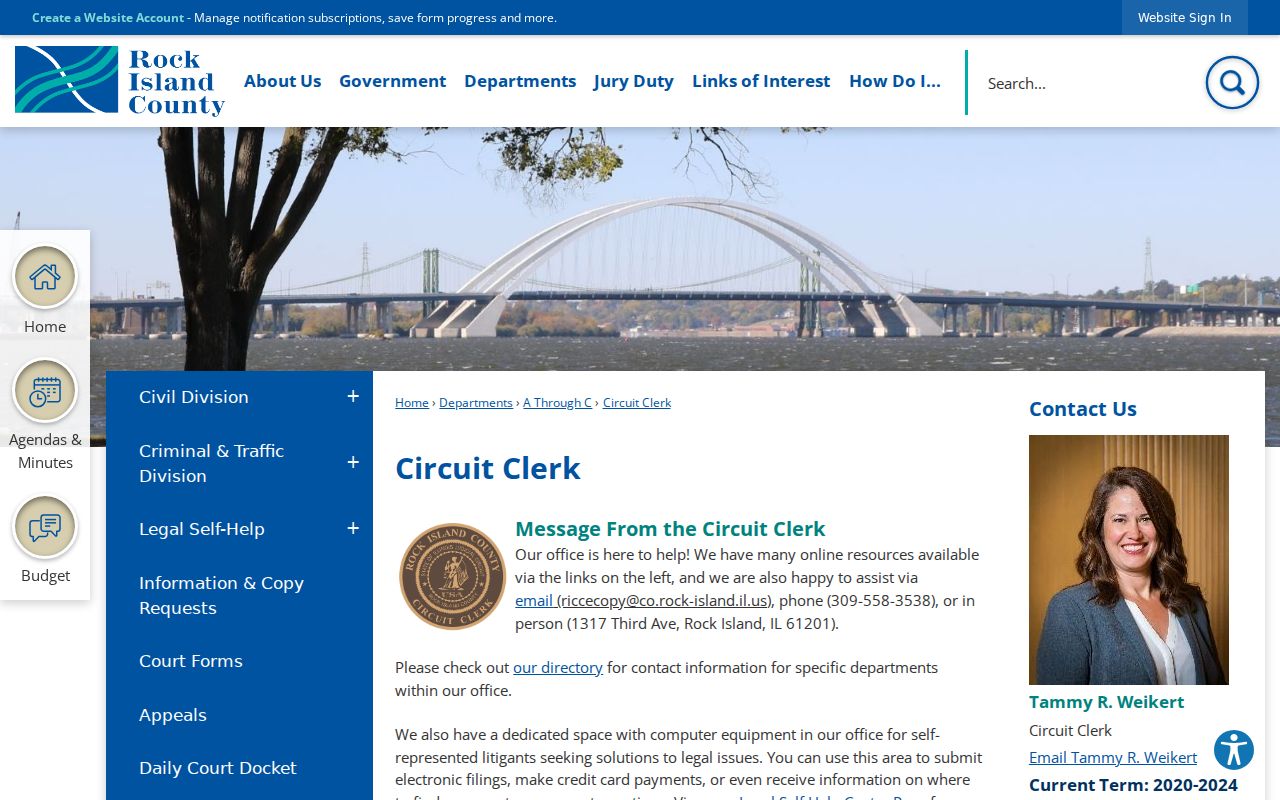
The clerk image reflects the public office that holds the filed case, while Judici is an index into much of that information. Public availability can vary by case. Sealed, expunged, juvenile, impounded, and other confidential matters do not appear like ordinary open files.
| Judici field | Use | Rock Island format |
|---|---|---|
| Court | Required county context | Rock Island County, IL081025J |
| Name | One search route | Last name, space, first name |
| Case Number | Alternate route | Four-digit year, case code, sequence |
| Search | Runs the query | Review the matching result with care |
| Reset or Clear | Starts over | Try a corrected name or number |
Illinois Official Background Checks
The Illinois State Police Bureau of Identification is the state criminal-history repository. Its Criminal History Information Response Process, called CHIRP, provides electronic inquiries under the Uniform Conviction Information Act. The public product is Illinois conviction information. It is not a complete arrest-and-disposition history, and it does not replace a Rock Island County court file or an arresting agency's report.
A person reviewing their own Illinois record uses ISP Access and Review through an Illinois-licensed live-scan fingerprint vendor. The subject should retain the transaction control number. ISP charges no processing fee for Access and Review, though the private vendor may charge to take prints. If a disposition is missing or wrong, the ISP Record Challenge process accepts supporting clerk or agency documents.
The official CHIRP entry screen shows the gateway to the state's electronic conviction inquiry.
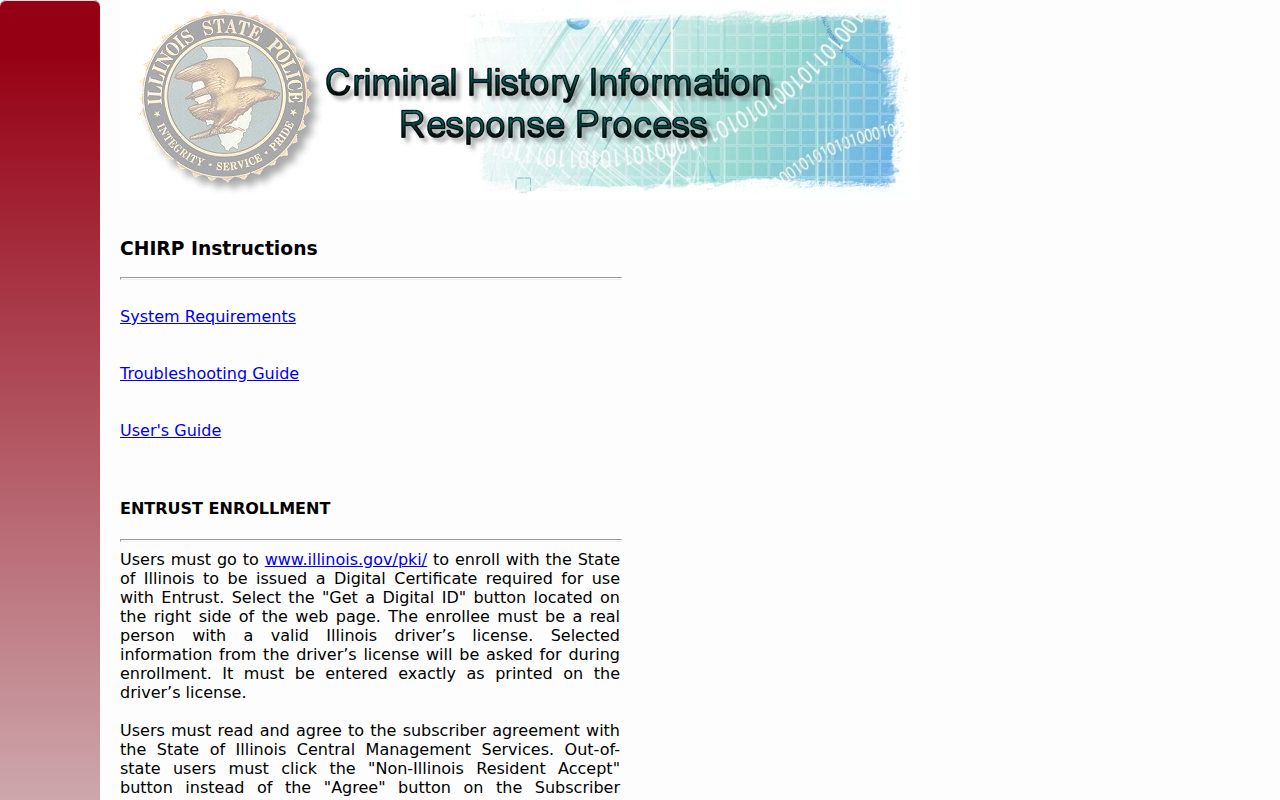
Authentication and user terms may limit what appears before sign-in. Use the current ISP vendor list for fingerprints because the research did not confirm a stable licensed storefront in Rock Island County.
Rock Island County Criminal Record Chain
One event can produce four records. The arresting office writes an incident and arrest report. Rock Island County central booking then creates custody identifiers, an inkless fingerprint submission, and a computerized booking image. A prosecutor decides which allegations to file, and the Circuit Clerk records the court case. Reportable biometric data and later dispositions are meant to link at the ISP repository.
The flow is best read in order: Police report → County booking → Prosecutor filing → Circuit Court outcome → ISP disposition link. Timing and purpose explain many mismatches. Intake charges may change before filing. A dismissal can resolve the case without erasing the source report or booking event. Delayed reporting or an unmatched fingerprint transaction may leave a state cycle without its final disposition.
The ISP Bureau of Identification overview identifies the central repository role.
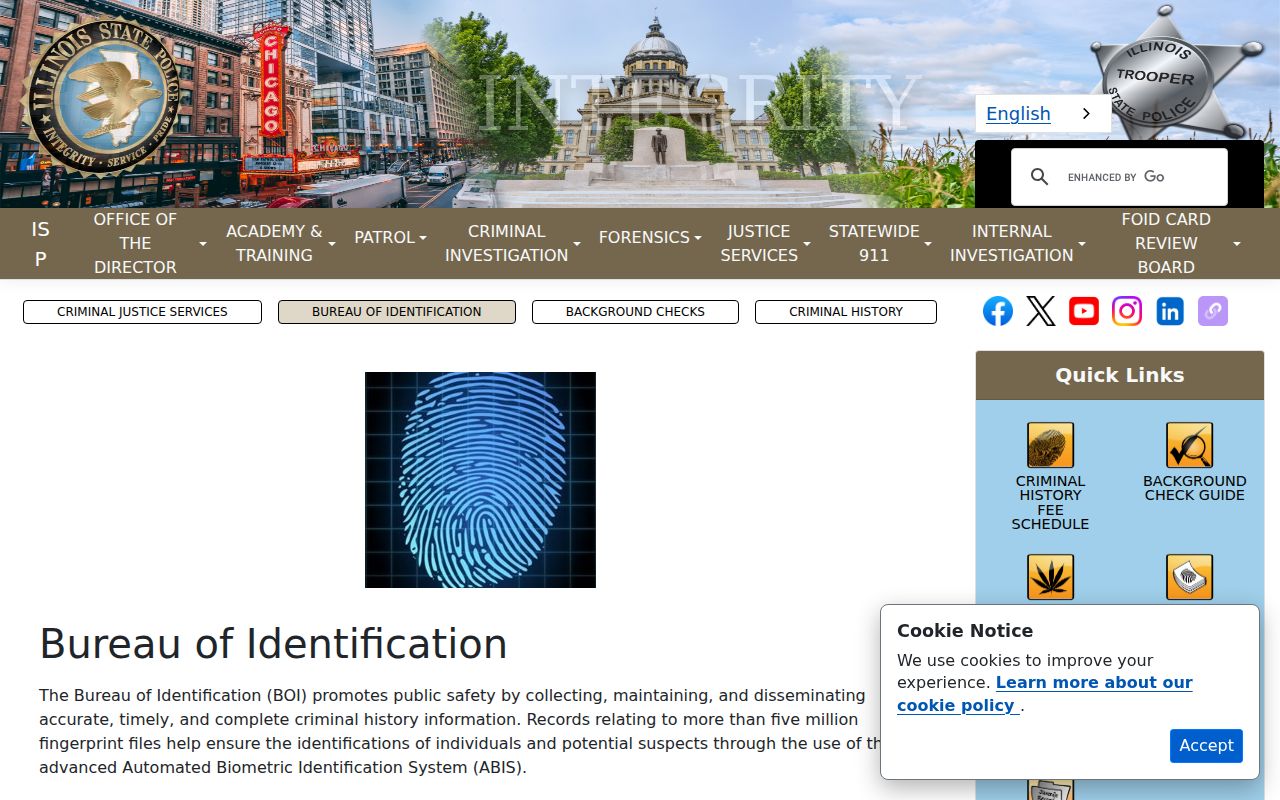
This statewide layer collects reported events, but the local clerk remains the source for the definitive Rock Island County judgment and certified court copy.
Criminal Record Types
Rock Island County agencies create records for different parts of a case. A police narrative, jail entry, court docket, and state history should not be treated as interchangeable. The source tells the reader what the entry can prove and what it cannot.
- Incident and arrest reports state investigative facts and the asserted basis for arrest; the arresting agency owns them.
- Booking records show county intake, fingerprints, custody, and charges presented when the person arrived.
- Court case files track filed CF felonies, CM misdemeanors, OV ordinance matters, CC contempt, pleas, orders, and outcomes.
- ISP history entries connect fingerprint-supported cycles and reported dispositions; public UCIA output is limited to conviction information.
- Warrant and supervision records may appear through a case, sheriff, court, RICCS, IDOC, or other lawful custodian, with access limits.
- Disposition
- The court result for a charge, such as dismissal, acquittal, or conviction.
- CF
- The Rock Island County case code for a felony file.
- CM
- The local code used for a misdemeanor case.
- Rap sheet
- A repository history built around identity and fingerprint-supported arrest cycles, not merely a court name search.
Rock Island County Criminal Booking Records
The Correctional Center at 1317 Third Avenue is the countywide central booking point. The sheriff reports more than 10,000 admissions per year. The connected jail and Justice Center have a total capacity of 325, an average daily population of 260, and a seven-day average stay. Those operational figures are not conviction counts. They include repeat admissions and people held for nearby communities or federal agencies.
The short average stay is why the Zuercher roster is only a present-custody snapshot. Release, transfer, spelling, or a data refresh can make yesterday's booking disappear. If the roster does not answer the question, call the jail at 309-558-3455 or request a historical booking record. For the underlying narrative, contact the sheriff only when a deputy made the report; Moline, Rock Island, and East Moline police retain their own reports.
The official Sheriff's Office description explains the central-booking function.
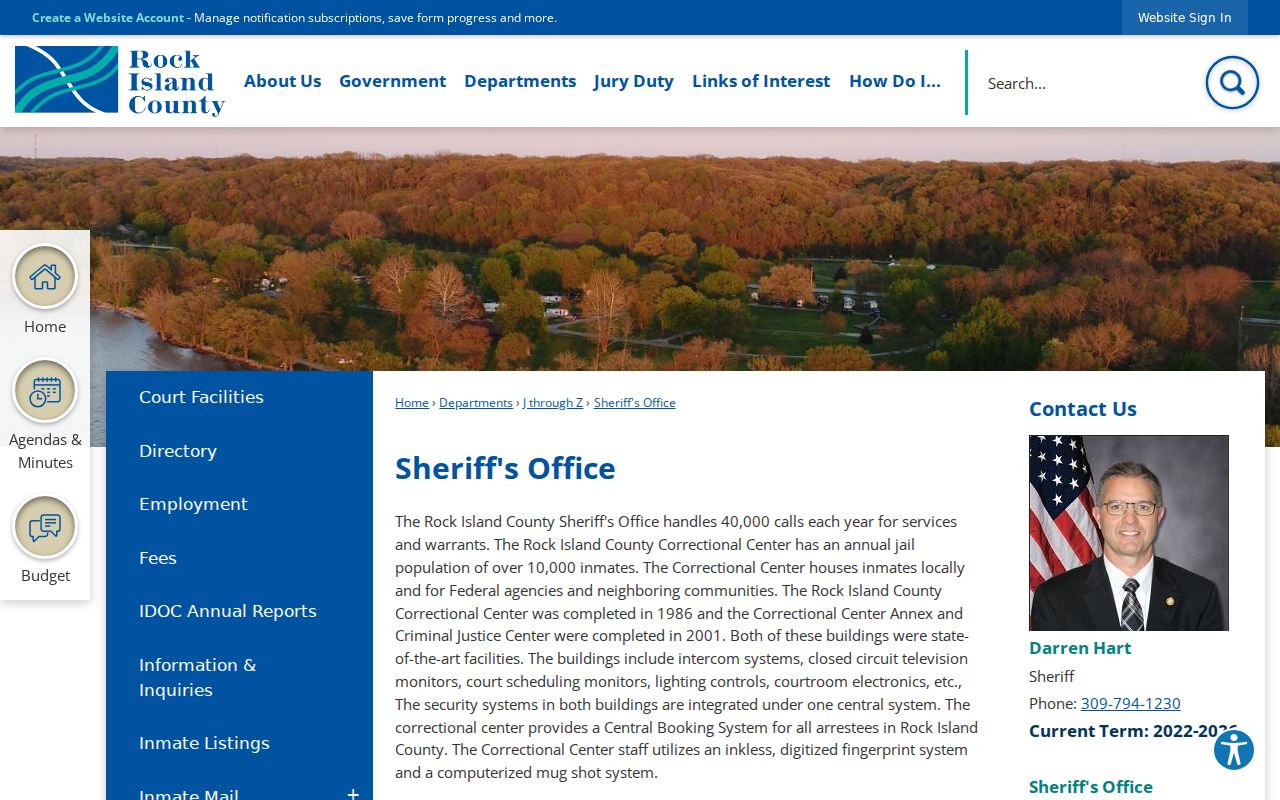
The sheriff image ties the custody record to its county custodian, not to the agency that necessarily investigated the event.
Inside a Rock Island County Criminal Record
A full Illinois self-review can connect identity data with fingerprint-supported arrest cycles. Expected identifiers include names and aliases, demographic details, state and FBI numbers when assigned, and transaction control numbers. Event entries may include an arrest date, agency, charge text, statute, prosecution tracking, disposition, sentence, and custody or supervision status. Public CHIRP conviction information is narrower.
| Name & Identifiers | Name, aliases, identity fields, state identification number, FBI number, and transaction references where assigned. |
|---|---|
| Arrest / Booking Data | Arrest date and agency, booking time, intake identifiers, fingerprints, and custody details. |
| Charges & Statutes | Alleged or filed counts, offense text, statute citations, and class, depending on the source. |
| Disposition | Dismissal, acquittal, conviction, or other court result reported for each filed count. |
| Sentence | Custody, probation, financial terms, or other orders entered by the court. |
| Custody / Supervision | County jail, IDOC, release, probation, or parole information where that custodian lawfully publishes it. |
A record does not prove every fact in the incident narrative. Obtain the source report for that detail. When a name-only match seems wrong, fingerprints are the sound way to review one's own repository history.
Rock Island County Criminal Record Offices
Routing a request to the right office prevents false no-record responses. The sheriff holds deputy reports and county booking material. The clerk holds filed court documents. RICCS handles probation and pretrial work, but most supervision details are not a public person-search product. The public defender represents qualifying defendants and is not a records counter.
Circuit Clerk
1317 Third Avenue, Suite 101
Rock Island, IL 61201
309-558-3538
Monday-Friday, 8:00 a.m.-4:30 p.m.
Sheriff's Office
1317 Third Avenue
Rock Island, IL 61201
309-794-1230
24-hour nonemergency/main line
Rock Island County Court Services
Ostrom Hall, 420 19th Street
Rock Island, IL
309-558-3700
Probation and pretrial programs
Published charges also differ by product. Clerk per-page and certification amounts were not captured in the official research, so request a current quote for court copies.
| Record service | Published fee |
|---|---|
| Sheriff accident report | $5 per report |
| Sheriff crime report, pages 1-50 | Free |
| Sheriff crime report after page 50 | $0.15 per page |
| CHIRP electronic UCIA inquiry | $10 |
| Manual UCIA inquiry | $16 |
| ISP Access and Review | $0 ISP fee; vendor capture may cost extra |
Public Access Laws in Illinois
The Illinois Freedom of Information Act governs sheriff, police, and other executive or local public-body records. A noncommercial request ordinarily receives a response within five business days, subject to a written five-business-day extension for statutory reasons. Active investigations, confidential sources, safety risks, juvenile data, private medical information, and protected techniques may justify withholding or redaction. Agencies should release reasonably separable nonexempt parts.
Court records follow a different route. Rock Island County's FOIA directory marks the Circuit Clerk as exempt from the Act. Judicial access runs through the clerk, court rules, statutes, and court orders. Send a court-copy request to the clerk rather than to a county FOIA officer.
Key Statutes:
5 ILCS 140 governs public-body requests, response times, fees, exemptions, and segregation of releasable material.
20 ILCS 2635 authorizes dissemination of Illinois conviction information through the UCIA system.
20 ILCS 2630 governs criminal identification records, correction, expungement, and sealing.
730 ILCS 152 provides for defined sex-offender community notification and restricts misuse.
Missing Rock Island County Criminal Records
A blank name search has several possible causes. The event may be too recent for a court filing. The name could be spelled another way, the case could use a four-digit year, or the incident could belong to Iowa or another Illinois county. Older documents may exist only through the clerk's terminal. A record may also be sealed, expunged, juvenile, impounded, or otherwise restricted.
For one's own record, compare the clerk disposition with ISP Access and Review. Retain the live-scan transaction control number. If the state entry lacks an outcome, use the ISP challenge packet and attach court or agency support. For a current custody question, call the jail because a seven-day average stay makes the roster change quickly. A warrant presents a separate risk: only the issuing court or serving agency can confirm current status, and an in-person inquiry can have enforcement consequences.
Official crime totals require the same care. The FBI Crime Data Explorer provides agency and year context.
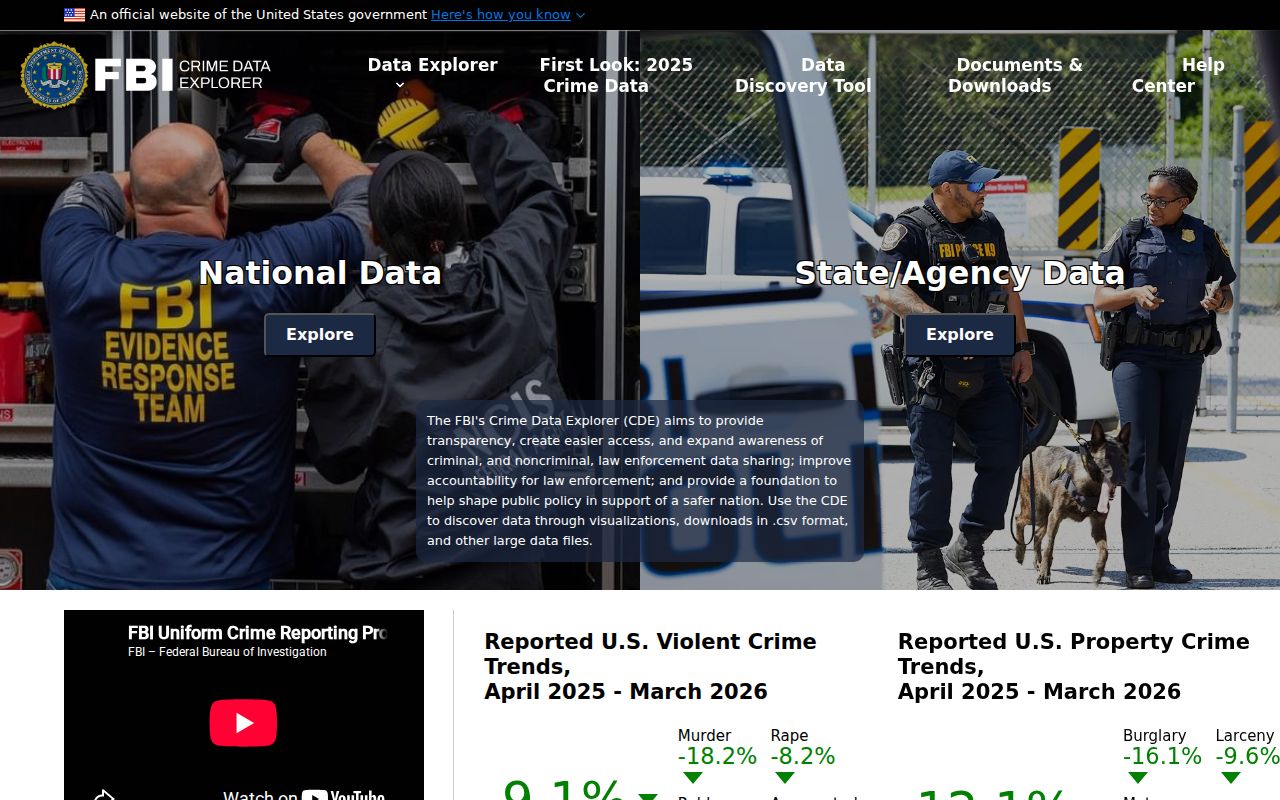
Missing agency submissions should never be counted as zero, and jail admissions should not be mislabeled as crimes or convictions.
Sealed, Expunged, and Restricted Records
Illinois uses both expungement and sealing. Expungement destroys or returns eligible participating law-enforcement records and removes identifying information as the statute allows. Sealing keeps the file but removes it from ordinary public view, while preserving access for authorized government purposes. Eligibility under 20 ILCS 2630/5.2 turns on the entire record, offense, disposition, supervision, waiting periods, and pending cases.
Start with current statewide Access to Justice forms linked by the Office of the State Appellate Defender. Identify each arresting agency and case, complete the petition, order, and notice papers, and file them with the Rock Island County Circuit Clerk. The county accepts cash, check, or money order. If relief is granted, the local page states that certification includes a further $60 ISP fee. Current statute and forms control because some county explanatory text dates to 2017.
The county expungement instructions show the local filing route and fee notice.
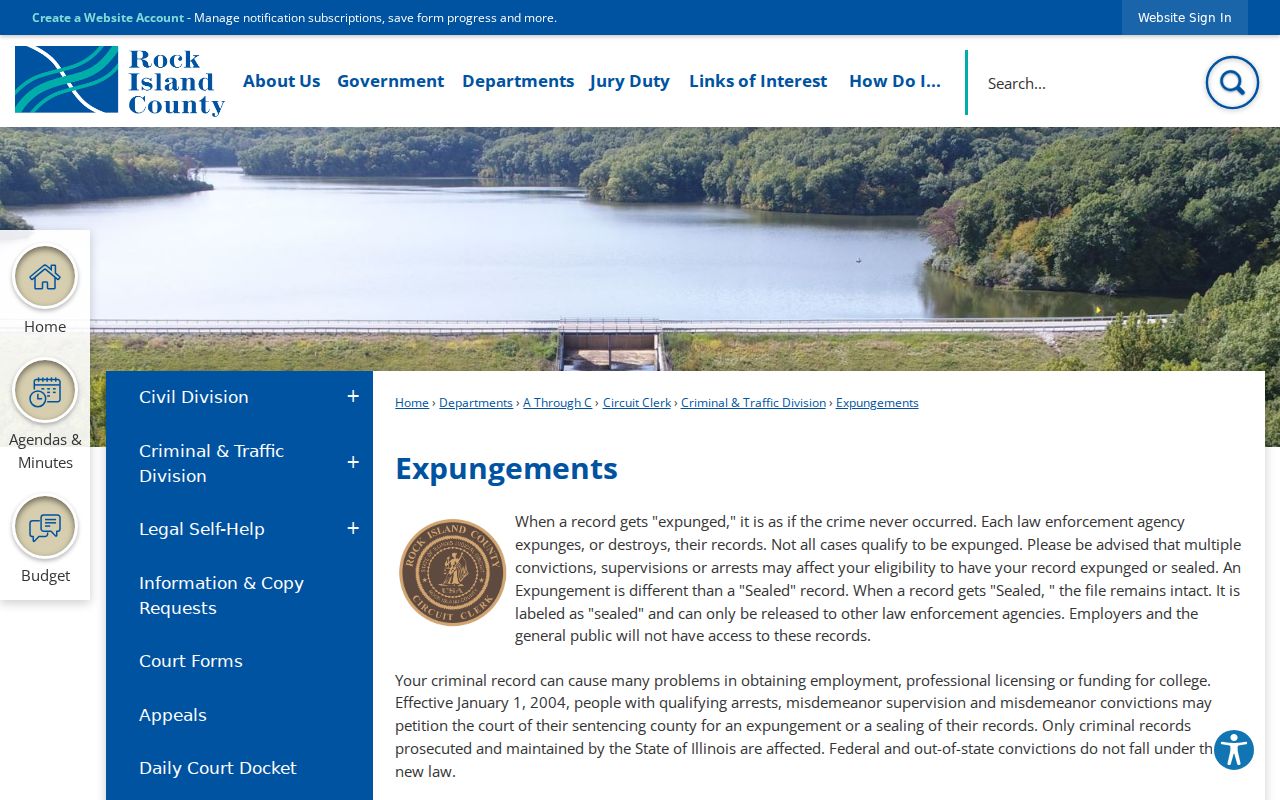
A hidden result is not proof of a legal clearing order. Juvenile and qualifying cannabis matters also follow distinct relief mechanisms.
Rock Island County Criminal Supervision Records
Rock Island County Court Services, known as RICCS, works from Ostrom Hall. Adult programs include probation intake and supervision, pretrial release, presentence investigations, DUI supervision, Mental Health Court, and a Domestic Batterer's Program. Juvenile intake, detention screening, supervision, and expungement resources are handled through a separate branch of this local structure.
Probation is a court sentence or supervision path. Parole or mandatory supervised release follows prison custody and involves the Illinois Department of Corrections Parole Division, with release-related duties assigned to the Illinois Prisoner Review Board. A public searcher should verify the sentence in the court case. Conditions, officer identity, tests, treatment, medical material, and presentence information may remain confidential.
The RICCS program page identifies the county's supervision services.
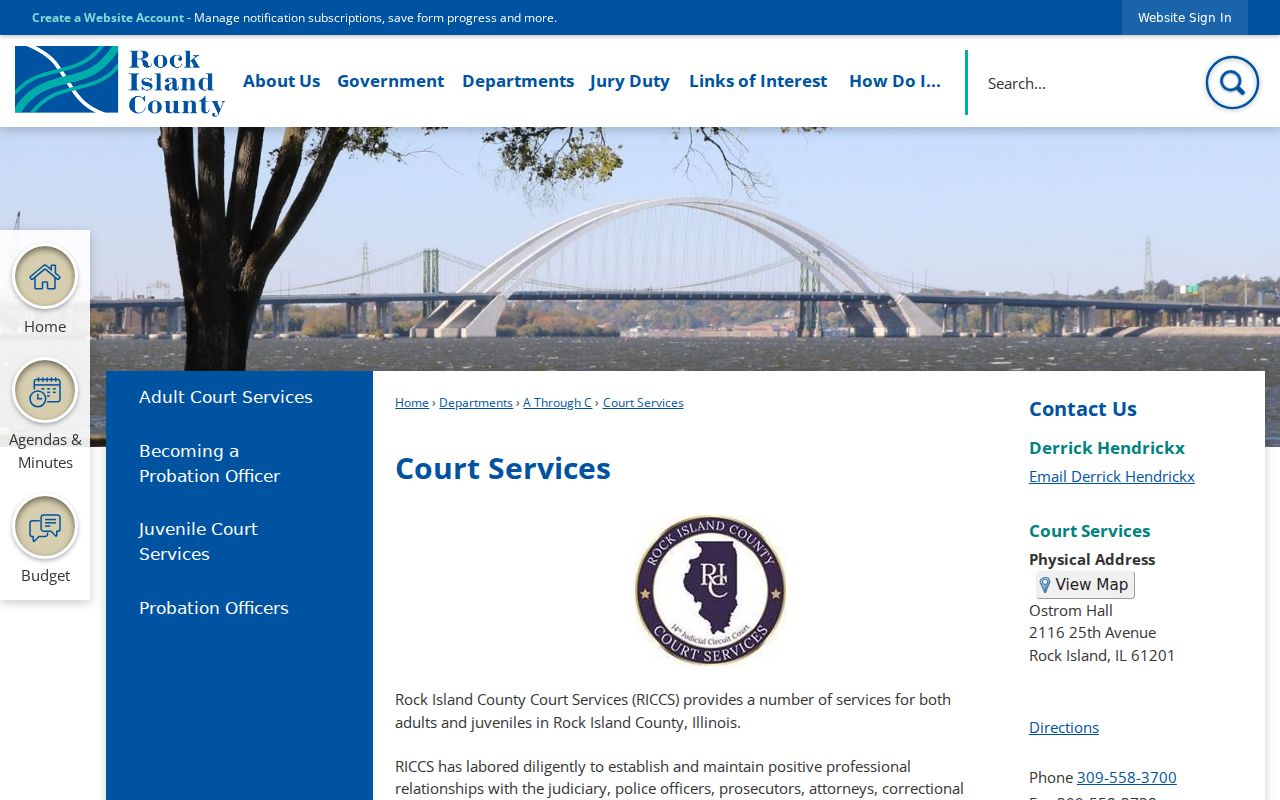
A petition to revoke or modify probation and the resulting order may appear in the public court file even when internal supervision notes do not.
Rock Island County Criminal Records by City
Moline, Rock Island, and East Moline are the county's three largest incorporated cities on a common 2024 Census estimate basis. Their police departments keep their own incident reports, while county central booking receives local arrestees and the Circuit Clerk holds filed criminal cases. Illinois has no separate constitutional municipal criminal courts for these cities. Civil code matters may go through MUNICES, but that administrative system is not a criminal court database.
Moline Criminal Records
42,442 · Moline Police supplies local report channels; criminal cases route to the county Circuit Court.
Rock Island Criminal Records
36,434 · City police reports, sheriff booking files, and clerk case records remain separate.
East Moline Criminal Records
20,995 · East Moline Police holds city reports; county systems hold booking and filed cases.
Rock Island County Criminal Record Boundaries
Rock Island County sits on the Illinois side of the Mississippi River in the Quad Cities. That label can hide the legal jurisdiction. An event in Davenport follows Iowa systems, while a Moline or Rock Island arrest follows Illinois channels. An incident at the federally administered Rock Island Arsenal may belong to a federal custodian even when someone casually describes the location as Rock Island.
Identify the place and arresting agency before sending a request. For Illinois city reports, use the correct police department. For county custody, use the sheriff and jail. For filed local charges, use Judici and the Circuit Clerk. State prison custody belongs in the IDOC Individuals in Custody Search, while federal court cases and federal prison placements use separate federal systems. Registry searches near the state line benefit from the national NSOPW layer because an Illinois-only county filter will not show Iowa registrations.
Note: A Quad Cities description is a geographic clue, not enough information to select the office that owns a criminal record.