
Checking Criminal History in Moline
A useful Moline criminal records check starts with the Moline event and its custodian. Moline Police Department holds the Moline incident or arrest narrative. Rock Island County central booking holds county custody intake. The Circuit Clerk and Judici hold the filed Moline case trail. Illinois State Police provides statewide conviction information through CHIRP and a separate fingerprint route for a person reviewing their own fuller Illinois record.
Use a complaint number, case number, date, exact place, and the correct name spelling when known. An agency can return no record if the request describes a Quad Cities event but points to the wrong city or state.
- Ask Moline Police for the incident report or face sheet when the event occurred within its jurisdiction.
- Give the complaint number, event date and location, record sought, desired format, and enough contact detail for a response.
- Search Judici for a filed ordinance, traffic, misdemeanor, or felony case in Rock Island County Circuit Court.
- Use the county custody channel for a recent Moline arrest because adults enter Rock Island County central booking.
- Use ISP CHIRP for statewide Illinois conviction information or Access and Review for one's own fingerprint-supported repository record.
Moline Face Sheet or Redacted Report
Moline makes a useful distinction between report products. A victim, or the parent of a juvenile victim, may obtain a public face sheet at no charge with proper identification. The request can be made in person or by a self-addressed stamped envelope. The face sheet normally states the complaint number, offense type, and property involved. It generally leaves out the narrative and other involved names.
A redacted report is broader and requires a Moline Police FOIA request. Redaction removes information that cannot lawfully be released. A complete investigative report is different again. The city says it requires a court-ordered subpoena delivered to the Records Custodian and carries a fee. Calling all three products a “police report” can cause delay because their content, legal route, and cost are not the same.
The Moline official police report page displays those Moline record-copy paths.
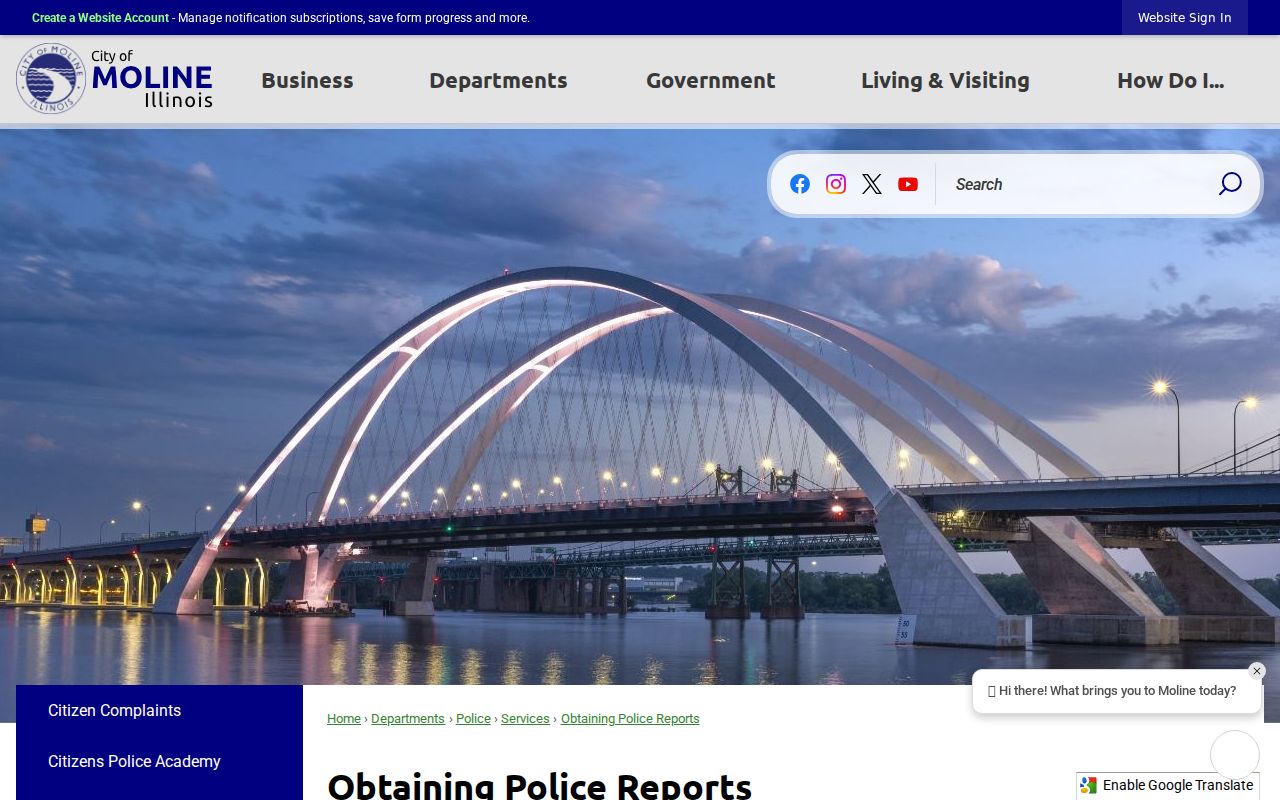
The page is the best starting point for selecting a face sheet, redacted copy, or subpoena route.
Moline Police Department Records
The Moline Police Department is at 1640 6th Avenue, Moline, IL 61265. Its nonemergency number is 309-797-0401. Records-copy hours are Monday through Friday, 7:00 a.m. to 5:00 p.m. The police records channel covers reports created by Moline officers. It does not become the custodian for a county jail booking or Circuit Clerk case merely because the event began with a city arrest.
Moline's police FOIA contact is policefoia@moline.il.us and 309-524-2015. A useful Moline request includes the requester's contact information, complaint number if known, Moline event date and location, a clear record description, inspection or copy preference, delivery format, and the commercial-purpose and fee-waiver answers when they apply. The Moline online form also exposes Email, Mail, In Person, and Fax delivery choices plus an electronic signature.
The official department profile shows the local agency responsible for these city records.
Use this office for the source narrative, then change custodians when the question moves to booking or court.
Describe Moline Police Records Precisely
A precise Moline records request is easier to route and review. State the exact record sought, such as a public face sheet, redacted incident report, crash report, or a defined part of a file. Add the complaint number, event date, location, and involved party. Choose inspection or a copy and name the desired format. If the number is unknown, a narrow date and place can help the records staff find the event.
The first 50 pages are free. Additional pages cost $0.15 each, and certification costs $1. Moline notes that a victim's report in a violent-crime case is not charged under the cited Illinois victim-rights provision. Effective in 2026, an emailed request should place its text in the email body rather than provide only an attachment or link. That small step makes the request visible without forcing staff to open an outside item.
Note: A five-business-day FOIA response period does not promise that a requested report will be available for same-day pickup.
Moline Arrests and Bookings
Moline Police creates the arrest and incident records for its enforcement action, but adults arrested in Moline enter Rock Island County central booking at 1317 Third Avenue. The booking system captures custody identifiers, digital fingerprints, a booking image, intake allegations, and bond or custody information. The source police report remains with Moline. A current jail record remains with the county. They answer different questions.
A recent Moline booking can appear before a prosecutor files a case. It may also disappear from a current-custody list after release or transfer. Filed Moline charges can differ from the allegations recorded at arrest. For that reason, a Moline criminal record review should compare the Moline report with the county custody entry and later court history only when the question calls for all three. The broader county arrest lookup explains the booking channel in more depth.
Pin Moline Events to an Agency
Moline is an industrial Mississippi River city in the Quad Cities. That regional label is not precise enough for a records request. The metro crosses city, county, and state lines. An account that says only “Quad Cities police” may concern Moline, Rock Island, East Moline, or an Iowa agency. Each department keeps its own source report.
Start with the exact Moline address, incident number, officer agency, citation header, or booking source. Then send the Moline request to that custodian. A no-record answer from Moline does not establish that the incident did not happen. It may show only that a different agency created the file. This Moline jurisdiction check is especially useful near the Mississippi River, where ordinary descriptions may omit the state.
Municipal Court Records in Moline
Illinois has no separate constitutional Moline municipal criminal court. City ordinance, traffic, misdemeanor, and felony matters that enter court are filed in the Rock Island County Circuit Court. A city prosecutor may handle ordinance matters, but the public case-search routes are Judici and the Circuit Clerk, not a stand-alone Moline court database.
Moline also uses MUNICES, the Municipal Code Enforcement System, for civil building, zoning, parking, and qualifying ordinance tickets. Adults with qualifying ordinance tickets can go to MUNICES. Under-18 ordinance matters, traffic cases, and misdemeanors route to Circuit Court. A MUNICES hearing officer may impose fines, but the system is administrative and should not be described as a criminal court.
The city's official court-routing page shows where Moline ordinance, traffic, and criminal matters go.
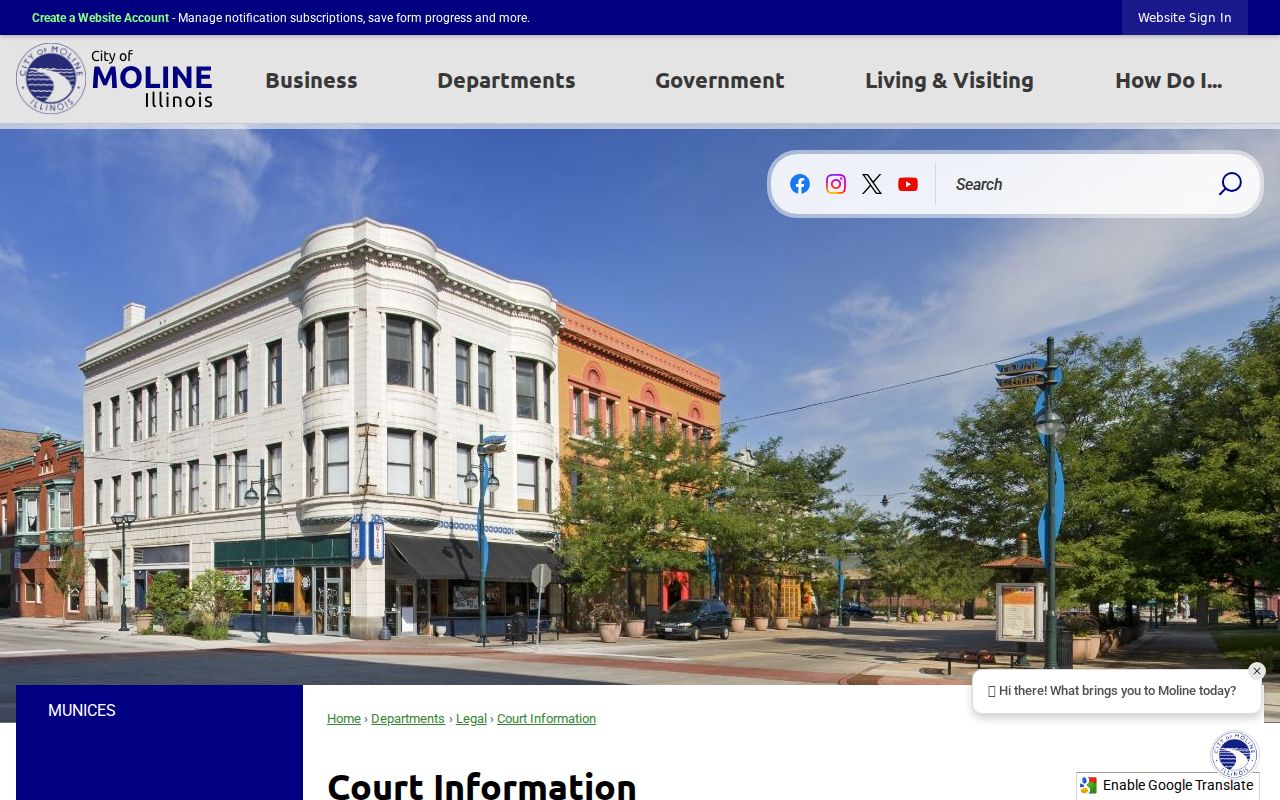
The routing distinction prevents an administrative ticket search from being mistaken for a criminal docket search.
| Court Name | Rock Island County Circuit Court of the Fourteenth Judicial Circuit. |
|---|---|
| Case Types | Moline ordinance matters routed to court, traffic, misdemeanor, and felony cases. |
| Administrative Track | MUNICES handles qualifying civil code and ordinance tickets; it is not a criminal court. |
| Case Lookup | Judici online, the Circuit Clerk's free public terminal, or the clerk's copy channel. |
| Docket Contents | Case number, parties, status, charges, events, disposition, sentence, future dates, and published financial details. |
| Definitive Copies | The Circuit Clerk supplies standard or certified copies; certified copies cannot be emailed. |
Search Moline Cases in Judici
Judici is the county's official online case index. For a Moline name search, enter the last name, a space, and the first name. A known felony case number needs a four-digit year. For example, a notice shortened to 04CF1234 must be searched as 2004CF1234. Open a result, select the case number, and choose History near the name and case number to review court events and updated hearing dates.
A Moline daily docket result answers whether a matter is scheduled, not how it ended. If the needed Moline document is not online, use the Circuit Clerk's free public terminal or email riccecopy@co.rock-island.il.us. Give the Moline case number, names, approximate year, case type, and exact documents sought. Standard copies may be emailed; certified copies cannot.
| Judici Field | Format | Best Use |
|---|---|---|
| Court | Rock Island County, IL081025J | Keeps the search in the correct circuit-court index. |
| Name | Last name, space, first name | Finds possible Moline parties when no case number is known. |
| Case Number | Four-digit year + type + sequence | Opens a known CF, CM, OV, or other case directly. |
| History | Link within a case result | Shows published events, disposition, and future dates. |
Where Moline Records Go
One Moline event can create a city report, county booking, court file, and state criminal-history cycle. Moline officers write the source narrative. County central booking takes fingerprints and custody details. Prosecutors decide whether and what to charge. The Circuit Clerk records filings, pleas, dismissal or conviction, sentence, and later events. Reportable arrest fingerprints and dispositions are meant to reach the Illinois State Police Bureau of Identification.
Record flow: Moline Police Department › Rock Island County Courts › Illinois State Police Bureau of Identification
Timing can create mismatches across Moline records. A Moline booking may precede a filed case, and a final disposition may take time to attach to a state arrest cycle. For recent Moline facts, check the Moline report and county custody source. For adjudication, use the Moline court file. ISP UCIA is statewide conviction information, not a complete Moline incident or arrest history.
Moline Crash Records Use BuyCrash
Moline uses LexisNexis BuyCrash for crash reports beginning January 1, 2021. Reach it through the city's official police report page. That official route matters because commercial pages with similar names can obscure whether the city actually authorized the service. A crash report is also not the same record as an incident narrative, jail booking, or court case.
Before ordering, confirm the event was handled by Moline Police and falls within the covered date range. Use the identifying information requested through the city-authorized link. If a crash also led to an arrest or court case, obtain those distinct records from the county or clerk only when needed. The crash portal does not become a general Moline criminal-history database.
Public Access Rules in Moline
The Illinois Freedom of Information Act governs Moline Police and other Moline public-body records. Its ordinary noncommercial response period is five business days, with a possible five-day extension. The Act permits exemptions for Moline records whose release would interfere with enforcement, impair a fair trial, expose confidential sources or techniques, endanger safety, or reveal protected personal and victim details. Moline must separate releasable material where practical.
Court records follow a different path. Rock Island County identifies the Circuit Clerk as exempt from the county FOIA directory. Judicial access instead runs through the clerk, court rules, statutes, and court orders. State conviction information has its own UCIA channel. These distinctions explain why one broad FOIA request cannot produce every Moline criminal record.
Key Statutes:
Illinois FOIA, 5 ILCS 140/3, 6, and 7 sets response timing, copy rules, exemptions, and the duty to separate releasable material.
Uniform Conviction Information Act, 20 ILCS 2635 governs public Illinois conviction information collected by ISP.
Criminal Identification Act, 20 ILCS 2630 governs state collection, correction, dissemination, expungement, and sealing processes.
When Moline Records Show No Result
A blank Moline search is a cue to test the source, spelling, date, and record type. Try a known Moline case number or name variation in Judici. Ask whether the Moline event was filed in another county or handled by another Quad Cities agency. A recent Moline arrest may not yet have a case, while a released person may no longer appear on a current-custody roster. Sealed, expunged, juvenile, impounded, and other confidential cases do not display like ordinary public files.
For one's own Illinois repository record, fingerprints are the sound way to avoid a name-only false match. ISP Access and Review supplies the subject's fuller review route, while Record Challenge addresses inaccurate or missing arrest and disposition links. Keep the case number and arrest date, obtain the clerk's final disposition, and provide supporting records through the ISP process when a state entry is wrong.